

A Comparison of Expat Salaries in the Middle East 2026
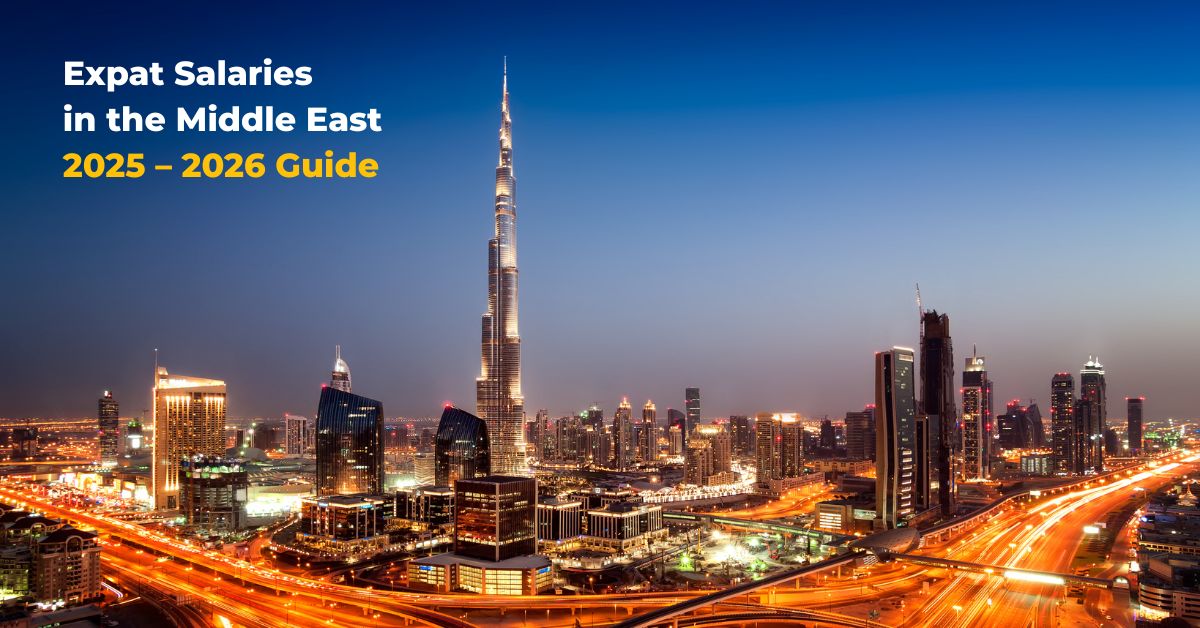
The Middle East continues to be a prime destination for expatriates seeking professional opportunities, driven by competitive salaries, tax-free income in many countries, and rapidly growing economies. As the demand for skilled labor increases, expat salaries in the Middle East are becoming a key consideration for those looking to relocate. In this article, we’ll explore how salaries for expatriates vary across the region, the factors influencing these figures, and the industries offering the best opportunities for professionals looking to move to the Middle East.
Quick Comparison: Average Expat Salaries by Country (2025–2026 Market Data)
Before diving into regional nuances, this detailed data table provides a high-level cross-border snapshot of average baseline salary windows, leading industry growth vectors, and the core fiscal benefits driving talent acquisition across the GCC marketplace. These ranges reflect standard corporate packages, though executive tiers often exceed these benchmarks based on international talent scarcity.
| Country | Average Monthly Salary Range | Top-Paying Industry Vector | Primary Financial Incentive |
|---|---|---|---|
| United Arab Emirates (UAE) | AED 15,000 – AED 45,000 | Banking, FinTech & Cyber Security | 100% Tax-Free Income + Lifestyle |
| Saudi Arabia (KSA) | SAR 12,000 – SAR 45,000+ | Giga-Projects, Energy & Infrastructure | Premium Executive Uplift Packages |
| Qatar | QAR 12,000 – QAR 45,000 | LNG Extraction & Heavy Civil Engineering | Comprehensive Housing & Schooling |
| Kuwait | KWD 1,000 – KWD 3,500 | Chemical Engineering & Petrochemicals | Highest-Valued Currency Benefit |
| Oman | OMR 800 – OMR 3,000 | Logistics, Manufacturing & Utilities | Significantly Lower General Living Costs |
| Bahrain | BHD 1,000 – BHD 3,500 | Investment Banking & Asset Management | High Disposable Income Retention |
Key Factors Influencing Expat Salaries in the Middle East
1. Economic Diversification and Development Plans
Many Middle Eastern countries, particularly those in the Gulf Cooperation Council (GCC), have pursued ambitious economic diversification strategies. Saudi Arabia’s Vision 2030, the UAE’s National Innovation Strategy, and Qatar’s National Vision 2030 are all designed to reduce reliance on oil exports and focus on sectors like technology, finance, tourism, and infrastructure. These initiatives have created an increased demand for skilled professionals across a wide range of industries, which has driven up salaries, particularly for highly specialized talent. Corporate transformation mandates mean businesses are actively scouting for international subject matter experts to establish local operating frameworks, ensuring competitive executive recruitment activity across regional commercial centers. Furthermore, these development plans require complex, long-term consulting frameworks, which fuel the growth of professional services firms and create multi-layered executive roles that require niche, highly sought-after global competencies.
2. The Demand for Skilled Labor
As these countries continue to modernize and diversify their economies, there is a growing demand for skilled labor, particularly in sectors like healthcare, IT, engineering, finance, and construction. Expats with specialized skills can often command higher salaries, especially in fields that are central to national development goals. The demand for professionals in the energy and technology sectors has been a significant driver of salary growth in recent years. This hyper-competition for upper-tier technical skills has forced regional firms to establish robust talent pipelines, leaning heavily on recruitment consultants to source global talent capable of delivering rapid ROI on multi-billion dollar domestic assets. Because localized educational frameworks are still scaling up to meet these highly technical needs, international recruitment remains a vital mechanism for regional economic growth, keeping the compensation metrics for top-tier expatriates highly favorable compared to Western employment markets.
3. Tax-Free Income and Other Benefits
One of the main advantages of working in the Middle East is the favorable tax environment. Many countries in the region, such as the UAE, Qatar, and Kuwait, offer tax-free income, which allows expats to keep more of their earnings compared to countries with high-income taxes. Even in countries like Saudi Arabia, which has introduced a small tax for higher earners or specific structural fees for dependents, the overall corporate income tax burden remains zero for personnel, making it vastly lower compared to many Western countries. When mapping out target financial savings, international candidates must assess the comprehensive remuneration matrix—evaluating how gross tax-free salaries translate into net disposable wealth when contrasted against local domestic living parameters. This fiscal framework essentially provides an immediate financial uplift for qualified workers, acting as a primary driver for global workforce migration into the Gulf cooperative zone.
Expat Salary Overview by Country
1. United Arab Emirates (UAE)
The UAE, particularly Dubai and Abu Dhabi, continues to be one of the most sought-after destinations for expatriates. The UAE’s tax-free income policy, coupled with a high standard of living, makes it a popular choice for skilled professionals. However, the cost of living in cities like Dubai can be high, particularly in terms of housing and schooling. On average, expat salaries in the UAE range from AED 15,000 to AED 45,000 per month, depending on industry and experience. The market rewards those with proven track records in agile transformation and cross-functional leadership, with top-tier consultancies offering premium allowances to attract best-in-class personnel from Western and Asian markets alike. In addition, the country’s status as a regional corporate headquarters means there is a highly mature market for executive benefits, corporate mobility allowances, and performance-driven bonus structures that heavily incentivize long-term career commitments.
Key Industries in the UAE:
- Finance and Banking: AED 25,000 – AED 60,000 per month
- IT and Technology: AED 20,000 – AED 50,000 per month
- Engineering and Construction: AED 18,000 – AED 50,000 per month
- Healthcare: AED 15,000 – AED 45,000 per month
2. Saudi Arabia
Saudi Arabia is experiencing significant economic changes, particularly with its Vision 2030 initiative aimed at diversifying the economy. Despite a growing focus on localizing the workforce through Saudization, there is still a strong demand for expats with specialized skills. Salaries in Saudi Arabia tend to be lower than in the UAE at mid-tier baselines but remain incredibly competitive, frequently scaling to premium heights at senior executive tiers in sectors like oil and gas, engineering, and finance. On average, expat salaries in Saudi Arabia range from SAR 10,000 to SAR 35,000 per month, with major giga-projects like NEOM, Red Sea Global, and Qiddiya offering unprecedented premium uplift packages to secure leading global directors. These packages often feature localized remote hardship allowances, executive housing compounds, and fully covered educational allowances for dependents, establishing Riyadh and evolving economic zones as top-tier hubs for elite corporate specialists.
Key Industries in Saudi Arabia:
- Oil and Gas: SAR 18,000 – SAR 50,000 per month
- IT and Technology: SAR 15,000 – SAR 45,000 per month
- Engineering: SAR 20,000 – SAR 45,000 per month
- Healthcare: SAR 12,000 – SAR 35,000 per month
3. Qatar
Qatar continues to attract expats due to its tax-free income and rapidly growing economy, especially in sectors such as construction, energy, and finance. Salaries in Qatar are among the highest in the region, with the added benefit of generous housing allowances and education benefits for expatriates. Salaries typically range from QAR 12,000 to QAR 45,000 per month, with senior-level professionals earning significantly more. Doha’s infrastructure landscape demands highly qualified project management offices (PMO) and specialized technical directors, ensuring that comprehensive compensation packages remain a staple for elite expat candidates navigating relocation. The long-term security of Qatar’s North Field expansion projects guarantees steady, high-value procurement roles for energy experts, ensuring the state remains a globally competitive draw for professional human capital.
Key Industries in Qatar:
- Oil and Gas: QAR 20,000 – QAR 70,000 per month
- Engineering: QAR 18,000 – QAR 50,000 per month
- IT and Technology: QAR 15,000 – QAR 40,000 per month
- Healthcare: QAR 12,000 – QAR 35,000 per month
4. Kuwait
Kuwait continues to hold a distinct position in the GCC due to the historic financial strength of the Kuwaiti Dinar (KWD), which remains the highest-valued currency in the world. This currency advantage provides a powerful baseline wealth-generation mechanism for expatriates moving to the state. While Kuwait has introduced rigorous regulatory oversight via its local workforce nationalization framework (Kuwaitization), the domestic market maintains an active reliance on upper-tier engineering and healthcare professionals. On average, standard expat salaries in Kuwait range from KWD 1,000 to KWD 3,500 per month, with executive leadership cadres in commercial operations securing substantially higher compensation benchmarks. This structural design heavily supports professionals seeking to prioritize maximum cash retention and liquid savings over their deployment duration.
Key Industries in Kuwait:
- Oil, Gas, and Petrochemicals: KWD 1,800 – KWD 4,500 per month
- Engineering and Project Management: KWD 1,200 – KWD 3,800 per month
- Healthcare and Medical Specialists: KWD 1,500 – KWD 4,000 per month
- Banking and Institutional Finance: KWD 1,100 – KWD 3,200 per month
5. Oman
While Oman’s salaries tend to be lower than those in neighboring GCC countries, it is still an attractive destination for expats due to its relatively lower cost of living. Oman is undergoing economic diversification, and the government is encouraging the growth of industries such as tourism, logistics, and manufacturing. Expat salaries typically range from OMR 800 to OMR 3,000 per month, depending on the industry and experience level. Muscat offers an exceptional quality of life for families, making it an ideal choice for professionals who value a balanced lifestyle alongside steady capital savings accumulation. The Sultanate’s strategic ports in Salalah and Duqm are evolving into major commercial logistics sectors, which is driving up specialized recruitment for supply chain directors and industrial operations engineers.
Key Industries in Oman:
- Oil and Gas: OMR 1,500 – OMR 4,500 per month
- Engineering: OMR 1,000 – OMR 3,500 per month
- Healthcare: OMR 900 – OMR 3,000 per month
- Education and Training: OMR 800 – OMR 2,500 per month
6. Bahrain
Bahrain has a lower cost of living compared to its neighbors, making it a more affordable destination for expatriates. While salaries are generally lower than in the UAE or Qatar, they remain competitive, particularly in the banking and finance sectors where Manama maintains a historic reputation as a robust regulatory hub. On average, expat salaries in Bahrain range from BHD 1,000 to BHD 3,500 per month, allowing for an incredibly high lifestyle standard paired with excellent regional travel connectivity. Bahrain’s aggressive push into FinTech ecosystems and digital asset regulatory frameworks has sparked a distinct wave of recruitment for software compliance experts, digital banking architects, and risk management consultants looking for high saving metrics.
Key Industries in Bahrain:
- Banking and Finance: BHD 2,000 – BHD 5,000 per month
- IT and Technology: BHD 1,500 – BHD 4,000 per month
- Engineering: BHD 1,000 – BHD 3,500 per month
- Healthcare: BHD 1,200 – BHD 3,000 per month
Key Trends Impacting Expat Salaries in the Middle East
1. Nationalization Efforts
Countries like Saudi Arabia and the UAE have introduced policies aimed at increasing the participation of local nationals in the workforce. These policies, often referred to as Saudization and Emiratization, may reduce the number of roles available to expats, particularly in administrative, entry-level, or lower-skilled positions. However, expats with specialized skills in high-demand sectors continue to command attractive salaries, as these fields remain highly critical to the countries’ long-term development plans. Companies focus their expatriate hiring budgets strictly on strategic talent that can mentor local professionals and accelerate executive knowledge transfer. This ensures that while total volume might drop, the quality and baseline valuation of expert expat packages remain exceptionally elevated across corporate matrices.
2. Remote Work and Global Talent Pools
The rise of remote work has had a profound impact on expat salaries in the Middle East. Many prefabricated hybrid employment models enable prefabricated cross-border personnel to live in lower-cost countries while rendering key technical services for corporate entities based in the GCC. This trend is likely to continue, allowing skilled professionals to benefit from the higher salaries offered by Middle Eastern employers while enjoying more affordable living conditions in regional talent hubs like Jordan, Lebanon, or Egypt. Consequently, employers are adjusting their compensation strategies to blend borderless digital hiring with traditional on-site expat relocations. This cross-border structure allows regional enterprises to remain highly flexible while managing corporate scaling costs efficiently.
3. Increased Focus on Benefits Packages
Employers in the Middle East are increasingly offering comprehensive benefits packages to attract and retain top talent. In addition to competitive salaries, expats can expect to receive structured housing allowances, private education benefits for children, premium healthcare insurance, and annual return flights home. As global competition for specialized workers intensifies across technology and clean energy sectors, employers are demonstrating a willingness to offer more attractive, all-inclusive compensation systems rather than focusing solely on basic salary increments. End-of-service gratuities, long-term savings schemes, and performance metrics are being completely revamped by regional HR departments to ensure corporate retention rates remain stabilized against competitive global alternatives.
Conclusion
The Middle East remains one of the most lucrative regions for expatriates, with tax-free income, high salaries, and attractive benefits packages. While salaries vary significantly across the region, the growing demand for skilled professionals in key sectors like engineering, IT, healthcare, and finance continues to drive compensation levels upwards. Expats should carefully consider the net value of their salaries, especially in premium cities like Dubai and Doha, where high housing and schooling expenses can impact the overall net value of their monthly savings. Additionally, the evolving nationalization policies and the increasing prevalence of remote work frameworks will shape salary trends in the coming years.
For those considering a move to the Middle East, the region offers substantial financial rewards and professional growth opportunities, making it an appealing destination for skilled expatriates across various industries.
Partner with Expertise Recruitment in the Middle East
Navigating the complex, rapidly changing compensation landscapes of the GCC requires a recruitment partner with deep regional expertise. Based in Lebanon and serving major economic hubs across the Middle East, Expertise Recruitment acts as the premier bridge between world-class organizational infrastructure and high-caliber global talent.
For Employers Seeking Elite Talent:
Are you looking to scale your regional operational presence, manage executive knowledge transfer, or fill highly technical, critical skills vacancies? Our dedicated recruitment consultants utilize an extensive, verified global network to match your corporate requirements with candidates capable of delivering immediate commercial value.
👉 Contact Our Client Solutions Team Today
For Professionals and Job Seekers:
Are you looking to take the next major step in your career, leverage competitive tax-free salaries, and relocate to a premier regional economic zone? We connect specialized corporate experts with leading employers offering comprehensive compensation structures across the UAE, Saudi Arabia, Qatar, Kuwait, Bahrain, and Oman.
👉 Explore Our Current Vacancies & Submit Your CV